
Building a home strength setup does not necessarily require a large multi-station machine. Soozier strength training equipment takes a more modular approach, with squat racks, bench press stands, pull-up stations, preacher curl benches, and related equipment that can be combined according to the exercises a user actually performs.
The adjustable squat rack with pull-up bar, for example, supports several fundamental movements within one station. Its rack height adjusts through ten positions, while the integrated pull-up bar adds bodyweight training. The supplied bar can accommodate standard plates with 1- or 2-inch holes and has a listed 220 lb capacity, while the pull-up station is rated to 264 lb.
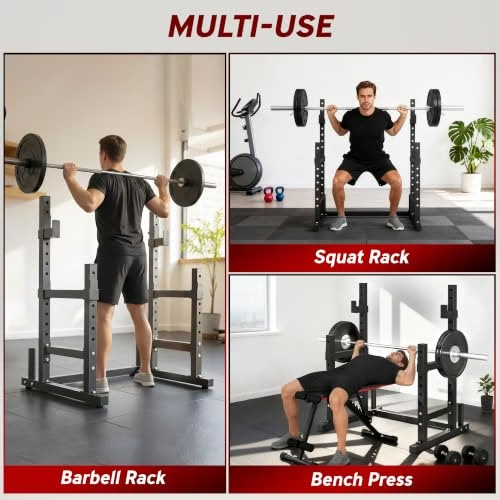
For users who already have their own barbell and plates, the heavier adjustable Soozier squat rack offers a different setup. Its two-tier rack provides separate positions that can be configured for squats, bench presses, and rack pulls. The upper rack is rated for up to 440 lb and the lower supports up to 660 lb, with safety spotter arms and integrated storage for 2-inch plates.
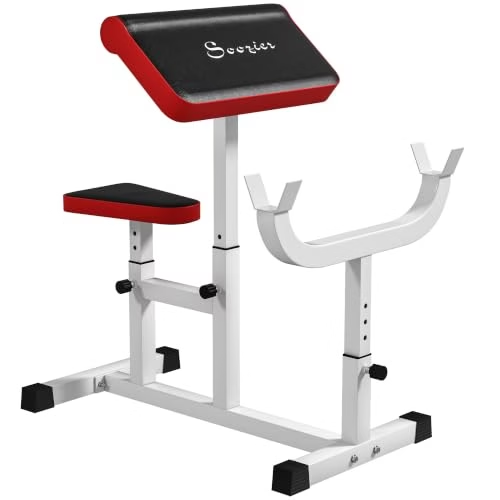
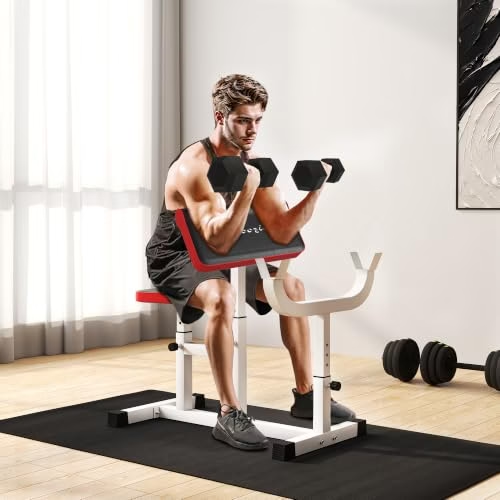
More specialized equipment can complement these compound movements. The Soozier adjustable preacher curl bench creates a supported position for dumbbell and barbell arm exercises, with adjustable seat, arm pad, and barbell rack heights. Rather than replacing a general-purpose rack, equipment like this allows a home gym to expand around particular training goals.
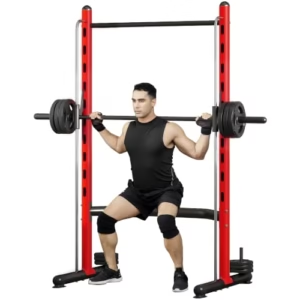
Soozier Adjustable Squat Rack with Guided Barbell and Pull-Up Bar
This home gym rack combines a guided barbell path with a pull-up bar for squats, bench presses, and pull-ups. Ten height settings accommodate different exercise positions, and the barbell accepts plates with 1-inch or 2-inch holes.
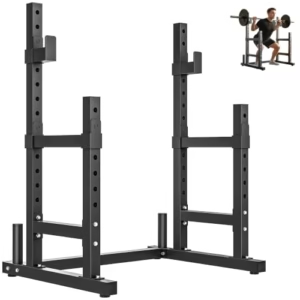
Soozier Adjustable Two-Tier Squat and Bench Press Rack, Black
This adjustable rack holds two barbells at separate heights for squats, bench presses, and rack pulls. Independent upper and lower settings, safety spotter arms, and two plate storage holders provide a flexible setup for home strength training.

Soozier Adjustable Preacher Curl Bench with Barbell Rack, White
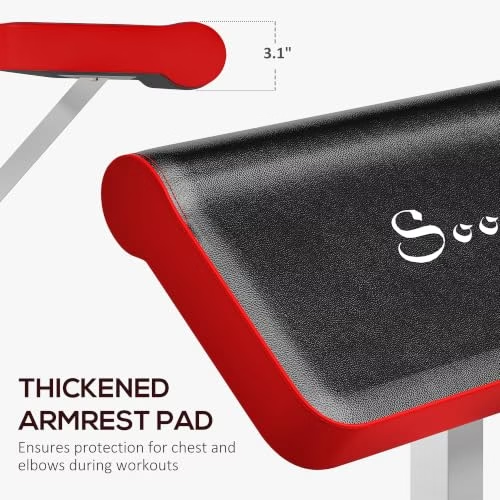
This preacher curl bench supports seated dumbbell and barbell biceps exercises. Independently adjustable armrest, seat, and rack heights help position the bench for different users, while a 3.1-inch-thick pad provides cushioning beneath the upper arms.
Soozier Adjustable Squat Rack with Guided Barbell and Pull-Up Bar
Description
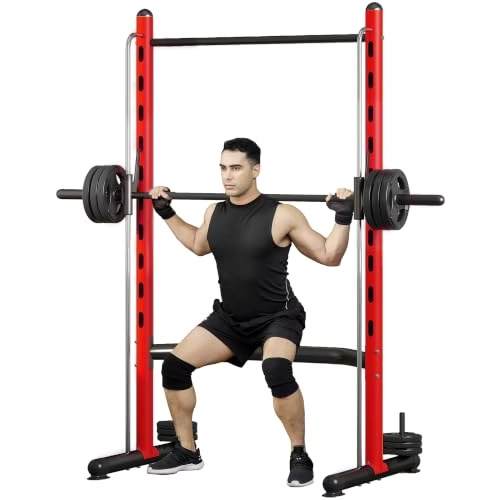
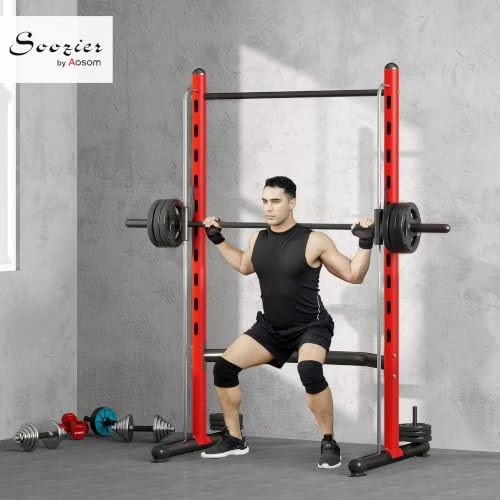
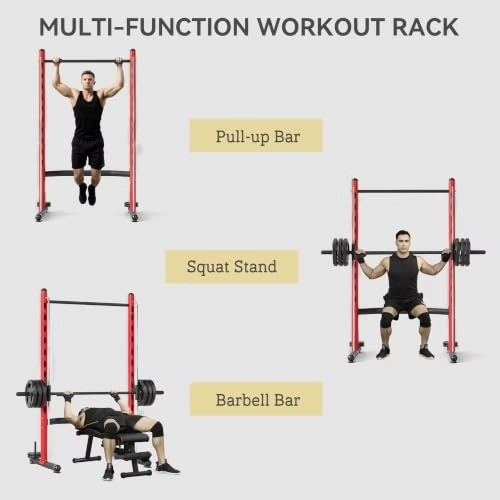
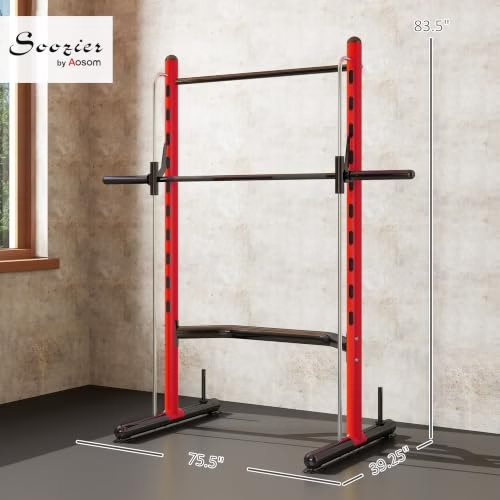
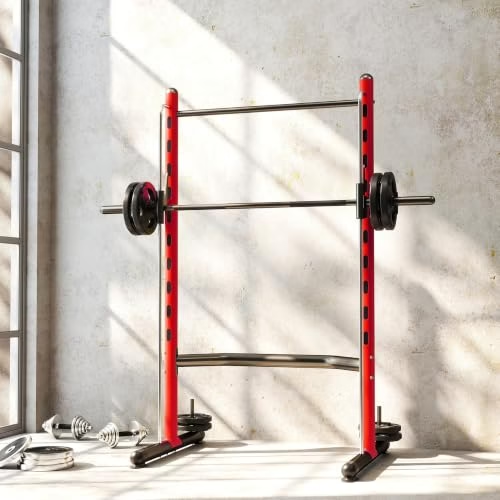
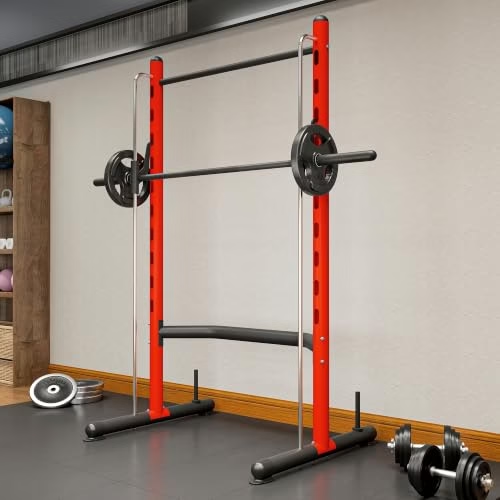
The Soozier adjustable squat rack provides a guided barbell path for squats and bench presses, along with an integrated pull-up bar for bodyweight exercises. The bar follows a fixed trajectory during lifting, which determines the movement path rather than allowing unrestricted barbell travel.
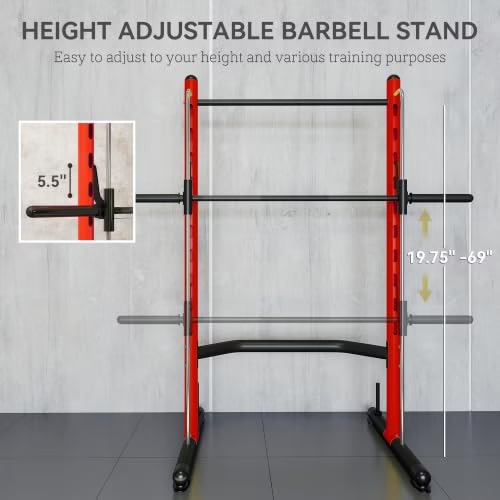
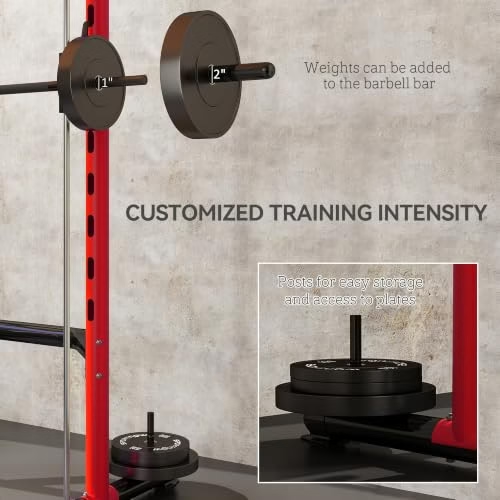
The listing specifies 10 height settings from 19.75 to 69 inches, allowing the lifting setup to be positioned for different exercises and users. The barbell accommodates weight plates with 1-inch or 2-inch center holes and has a listed capacity of 220 lbs. Weight plates are not included.
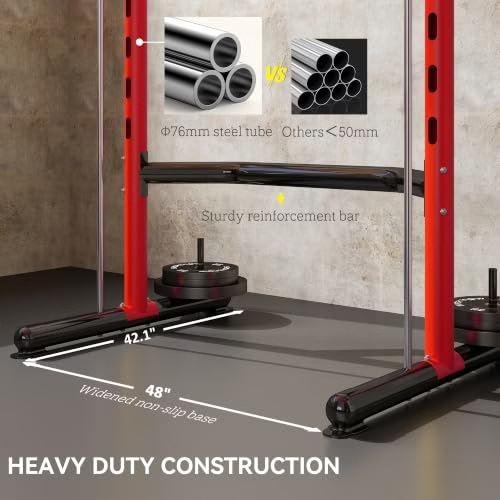
The frame uses 3-inch-diameter steel tubing and includes a curved support brace. Overall dimensions are 75.5 inches wide, 39.25 inches deep, and 83.5 inches high. The pull-up bar has a separate weight capacity of 264 lbs. Assembly is required, and the rack’s height and footprint should be considered when choosing a home workout space.
Features
- Guided barbell follows a fixed path during squats and bench presses
- Ten height settings allow the lifting setup to accommodate different exercise positions
- Barbell accepts weight plates with 1-inch or 2-inch center holes
- Integrated pull-up bar adds a bodyweight exercise option to the rack
- Steel tubing frame includes a curved support brace at the base
Specifications
- Brand
- Soozier
- Model
- A91-218V00RD
- Product Type
- Adjustable squat rack with guided barbell
- Color
- Black, Red
- Frame Material
- Steel
- Frame Tube Diameter
- 3"
- Dimensions
- 75.5" W × 39.25" D × 83.5" H
- Adjustment Height
- 19.75"–69"
- Height Settings
- 10
- Compatible Plate Hole Diameters
- 1" or 2"
- Barbell Capacity
- 220 lbs.
- Pull-Up Bar Capacity
- 264 lbs.
- Weight Plates Included
- No
- Assembly Required
- Yes
Soozier Adjustable Two-Tier Squat and Bench Press Rack, Black
Description
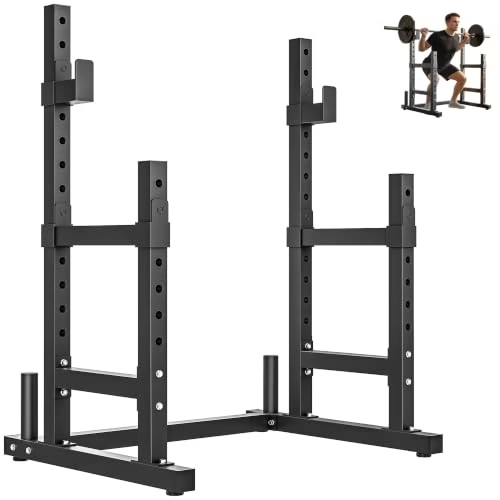
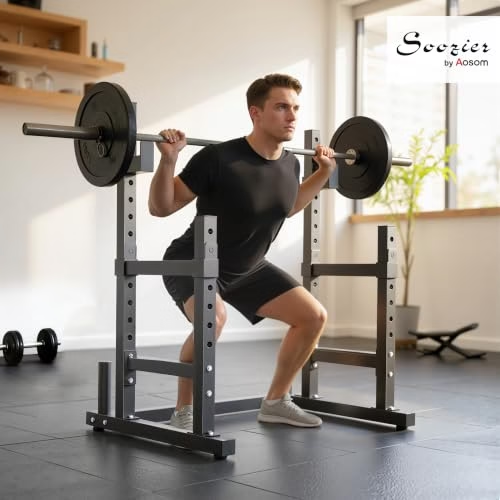
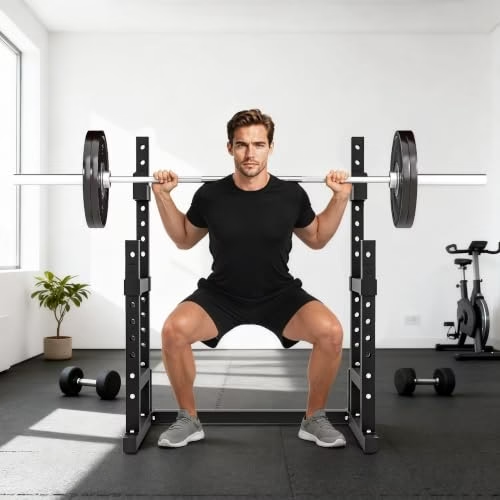
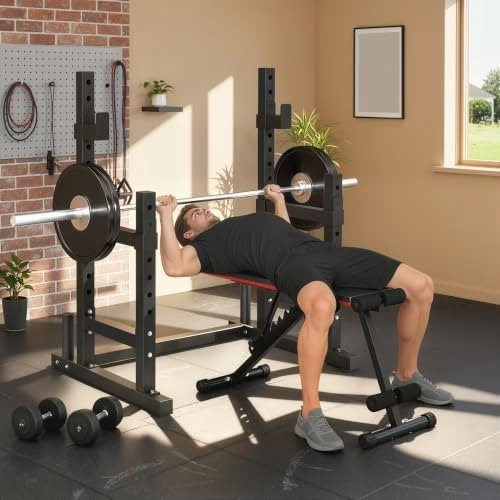
The Soozier adjustable squat and bench press rack features a two-tier barbell support design, allowing two barbells to be positioned simultaneously. This arrangement lets you prepare separate heights for different exercises, such as squats and bench presses, without resetting the same supports between movements.
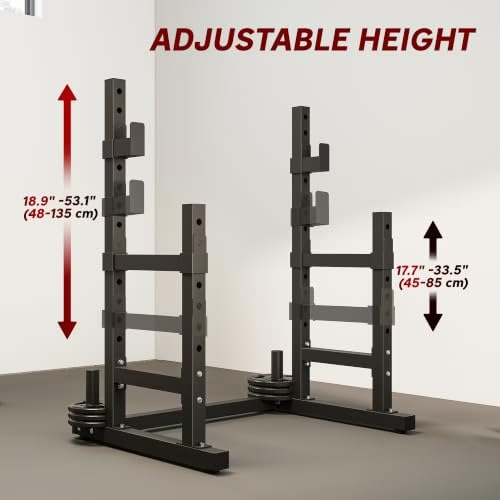
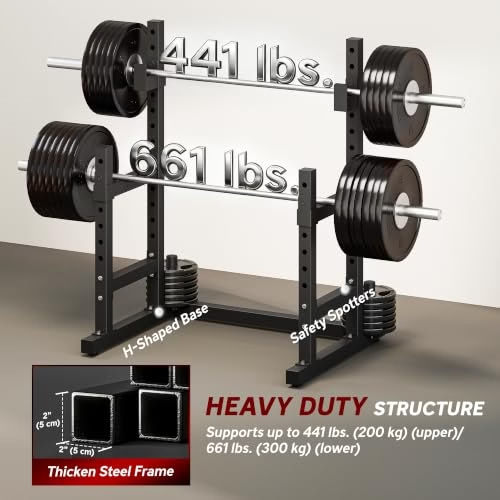
The upper rack offers 13 height settings from 18.9 to 53.1 inches, while the lower rack has six settings from 17.7 to 33.5 inches. Their listed load capacities differ: the upper rack supports up to 440 lb., and the lower rack supports up to 660 lb.
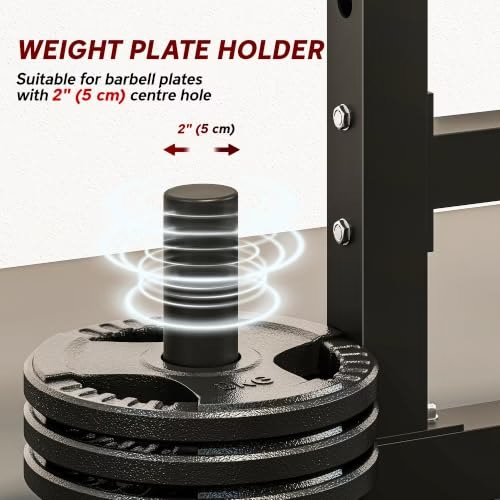
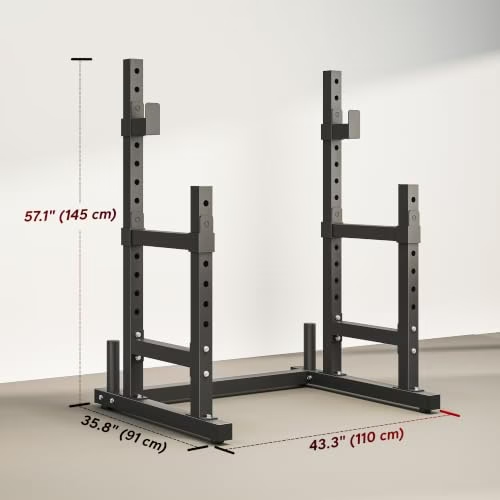
The frame uses 2 × 2-inch steel tubing with an H-shaped base and safety spotter arms. Two integrated storage holders accommodate plates with 2-inch holes, keeping stored plates close to the lifting area. The rack measures 43.3 inches wide by 35.8 inches deep and requires assembly. Barbells and weight plates are not included.
Features
- Two-tier support design allows two barbells to be positioned simultaneously
- Thirteen upper rack settings accommodate different bar heights for lifting exercises
- Six lower rack settings provide a separately adjustable barbell support position
- Safety spotter arms provide an additional support surface for the barbell
- Two integrated plate holders keep compatible weight plates near the rack
- Steel tubing frame uses an H-shaped base for floor support
Specifications
- Brand
- Soozier
- Model
- A91-406V00BK
- Product Type
- Adjustable squat and bench press rack
- Color
- Black
- Frame Material
- Steel
- Frame Tubing Size
- 2" × 2"
- Dimensions
- 43.3" W × 35.8" D × 57.1" H
- Upper Rack Height
- 18.9"–53.1"
- Upper Rack Positions
- 13
- Upper Rack Capacity
- Up to 440 lb.
- Lower Rack Height
- 17.7"–33.5"
- Lower Rack Positions
- 6
- Lower Rack Capacity
- Up to 660 lb.
- Plate Storage Holders
- 2
- Plate Holder Dimensions
- 2" diameter × 7.9" L
- Compatible Storage Plate Hole Diameter
- 2"
- Base Shape
- H-shaped
- Safety Spotter Arms
- Included
- Barbells Included
- No
- Weight Plates Included
- No
- Assembly Required
- Yes
Soozier Adjustable Preacher Curl Bench with Barbell Rack, White
Description
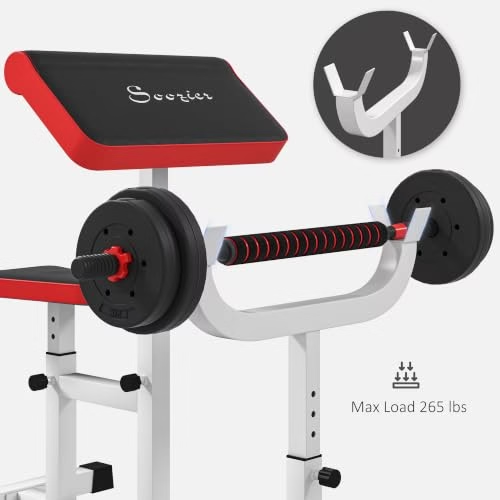
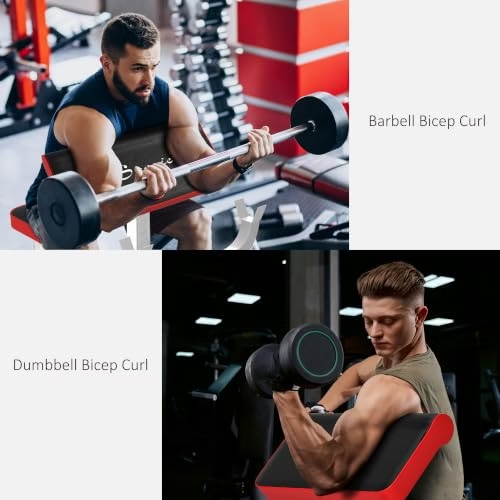
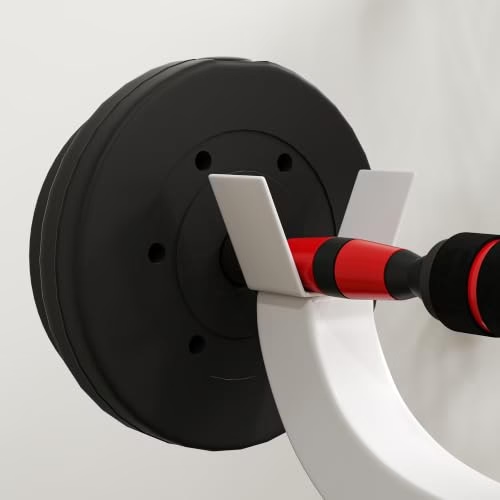
The Soozier preacher curl bench provides a dedicated station for seated dumbbell and barbell curls. Its angled arm pad supports the upper arms during exercise, and the integrated barbell rack provides a place to rest the bar between sets.
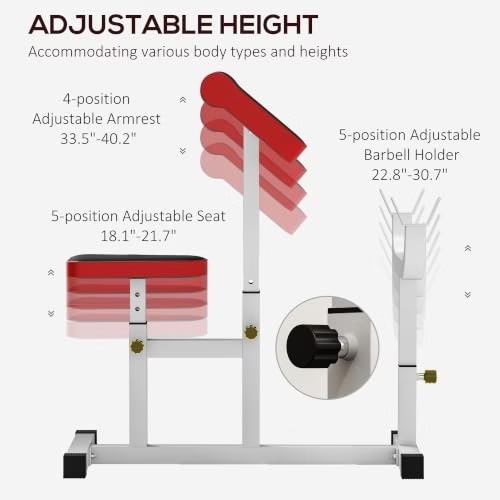
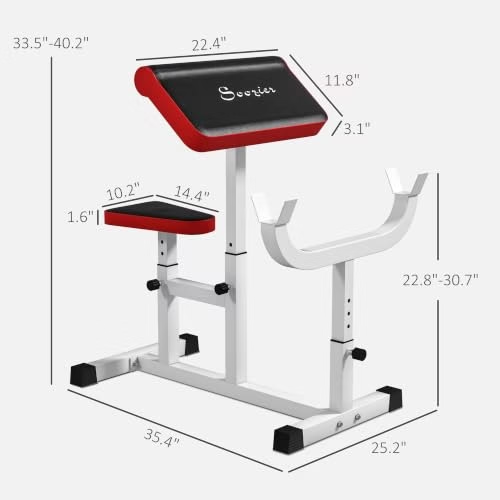
The armrest adjusts to four positions from 33.5 to 40.2 inches. The seat and barbell rack each offer five height settings, allowing their positions to be adjusted separately. These adjustments help users set the seat, arm support, and bar access to suit their proportions.
A 3.1-inch-thick preacher pad cushions contact with the chest and elbows. Its PU cover is described as sweat-resistant. The frame uses steel tubing with non-slip foot covers, and the assembled bench measures 35.4 inches long by 25.2 inches wide. The listing states a maximum load of 265 lbs., but does not specify separate user and rack capacities. Assembly is required.
Features
- Four armrest height settings help position the upper arms for preacher curls
- Five seat positions allow seating height to be adjusted independently
- Five barbell rack settings adjust the bar’s resting height between sets
- Thick preacher pad cushions chest and elbow contact during seated curls
- PU pad cover provides a sweat-resistant surface for routine workouts
- Steel tubing frame includes non-slip foot covers for floor contact
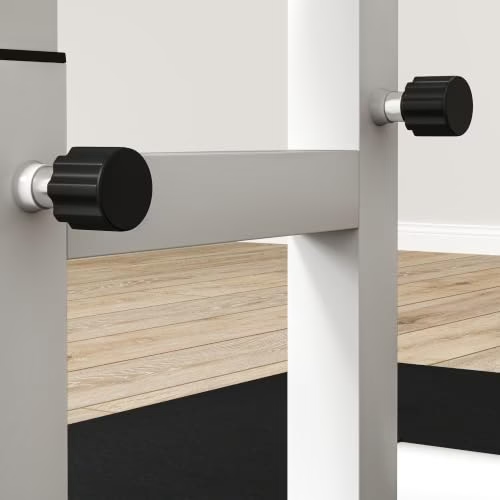
Specifications
- Brand
- Soozier
- Model
- A91-368V00WT
- Product Type
- Preacher curl bench with barbell rack
- Color
- White
- Frame Material
- Steel tubing
- Pad Cover Material
- PU
- Dimensions
- 35.4" L × 25.2" W × 33.5"–40.2" H
- Pad Thickness
- 3.1"
- Armrest Height
- 33.5"–40.2"
- Armrest Positions
- 4
- Seat Height
- 18.1"–21.7"
- Seat Positions
- 5
- Barbell Rack Height
- 22.8"–30.7"
- Barbell Rack Positions
- 5
- Maximum Load
- 265 lbs. (load allocation unspecified)
- Foot Covers
- Non-slip
- Assembly Required
- Yes
- Warranty
- 1 year against manufacturer defects
How to Build a Home Strength Training Program
For a beginner, the most useful approach is usually to build a program around movements rather than individual muscles. A balanced routine should include exercises that involve the legs, pushing movements, pulling movements, and some direct core or accessory work.
Squats are one of the natural starting points for a rack-based setup. Begin with a manageable resistance and learn consistent depth, stance, and bar control before increasing weight. A rack should be adjusted so that the bar can be unracked without standing on the toes or performing a partial squat just to remove it.
Bench pressing requires a compatible bench as well as correctly positioned rack supports and safety equipment. Set the rack so the bar can be removed while maintaining a stable shoulder position. When training with challenging loads, appropriate spotting or safety provisions become particularly important.
Pull-ups and chin-ups provide a different form of resistance because body weight supplies the load. Beginners who cannot yet perform full repetitions can work on controlled hangs, assisted variations, and slow eccentric repetitions. More experienced users can incorporate conventional pull-ups into back and upper-body sessions.
A preacher curl bench is best treated as accessory equipment rather than the foundation of a strength program. Its supported arm position makes it useful for controlled biceps work after larger exercises such as rows or pull-ups. Dumbbells can allow each arm to work independently, while a barbell makes bilateral repetitions convenient.
Progress does not require adding weight every workout. Increasing repetitions with the same resistance, improving movement control, performing an additional set, or gradually increasing the load are all forms of progression. For beginners, consistency and technique are generally more useful than frequently testing maximum weight.
Which Soozier Strength Training Equipment Fits Your Goals?
| Your Goal | Useful Equipment | Key Exercises | Beginner Approach | What It Helps Develop |
|---|---|---|---|---|
| Start strength training at home | Adjustable squat rack + barbell | Squat, press variations, rows | 2–3 full-body sessions per week | General strength and movement confidence |
| Build lower-body strength | Squat rack | Squats, split squats, rack-based barbell exercises | Start with moderate resistance for 8–12 controlled reps | Quads, glutes, hamstrings and overall leg strength |
| Develop chest & pressing strength | Bench press rack + compatible bench | Bench press, close-grip press | Use a load you can control throughout every repetition | Chest, shoulders and triceps |
| Train back & upper body | Rack with pull-up bar | Pull-ups, chin-ups, hangs | Begin with assisted or partial variations if necessary | Back, arms and grip |
| Focus on arms | Preacher curl bench | Dumbbell curls, barbell curls | 2–3 sets of 8–15 controlled repetitions | Biceps and elbow-flexor strength |
| Build a compact home gym | Multi-function squat/pull-up rack | Squats, presses, pull-ups and accessory exercises | Prioritize equipment supporting several movements | More exercise options within limited floor space |
| Progress to heavier lifting | Heavy-duty adjustable rack with safety arms | Squats, bench press, rack pulls | Increase resistance gradually rather than testing maximums frequently | Progressive strength development |
| Train for general fitness | Rack + adjustable weights | Compound exercises combined into full-body sessions | 6–10 exercises across the week rather than isolating every muscle | Strength, muscular endurance and regular physical activity |
Always stay within the stated capacity of the specific rack, bar, bench, and other components being used. The capacity of one part of a setup does not increase the rated capacity of another.
Setting Up the Equipment Correctly
Before training, place strength equipment on a firm, level surface with enough clearance for the barbell and the exercises being performed. A rack that technically fits into a room may still be unsuitable if there is not enough lateral space to load plates or enough overhead clearance for pull-ups.
Adjust rack heights before adding substantial weight. Safety arms or spotters should be positioned for the particular exercise and user rather than left permanently at one setting. Check fasteners periodically, particularly during the first weeks after assembly.
Weight plates should be loaded evenly on both sides of a barbell and secured appropriately. Integrated plate holders can help keep the workout area organized while also adding weight to the rack, but plates, barbells, and dumbbells should never be left where they create a trip hazard.
It is also important to distinguish between the capacities of individual components. A rack rated for 660 lb does not mean that every barbell, bench, attachment, or other component used with it can safely support the same load.
Make Strength Training Easier to Keep Consistent
For many people, the difficult part of strength training is not finding exercises—it is making regular training convenient enough to continue. Traveling to a gym, waiting for equipment, or trying to assemble a workout from equipment scattered around the house adds friction to a routine.
Soozier strength training equipment can create a permanent or semi-permanent training area at home, with racks and specialized stations supporting exercises that would otherwise require access to a gym. A squat rack can provide the foundation for compound lifting, an integrated pull-up bar adds bodyweight training, and equipment such as a preacher curl bench allows more targeted work as the home gym develops.
The practical benefit is straightforward: strength training becomes something that can fit into an ordinary week. A short session no longer requires a trip elsewhere, making it easier to turn progressive resistance exercise into a regular part of an active lifestyle.